


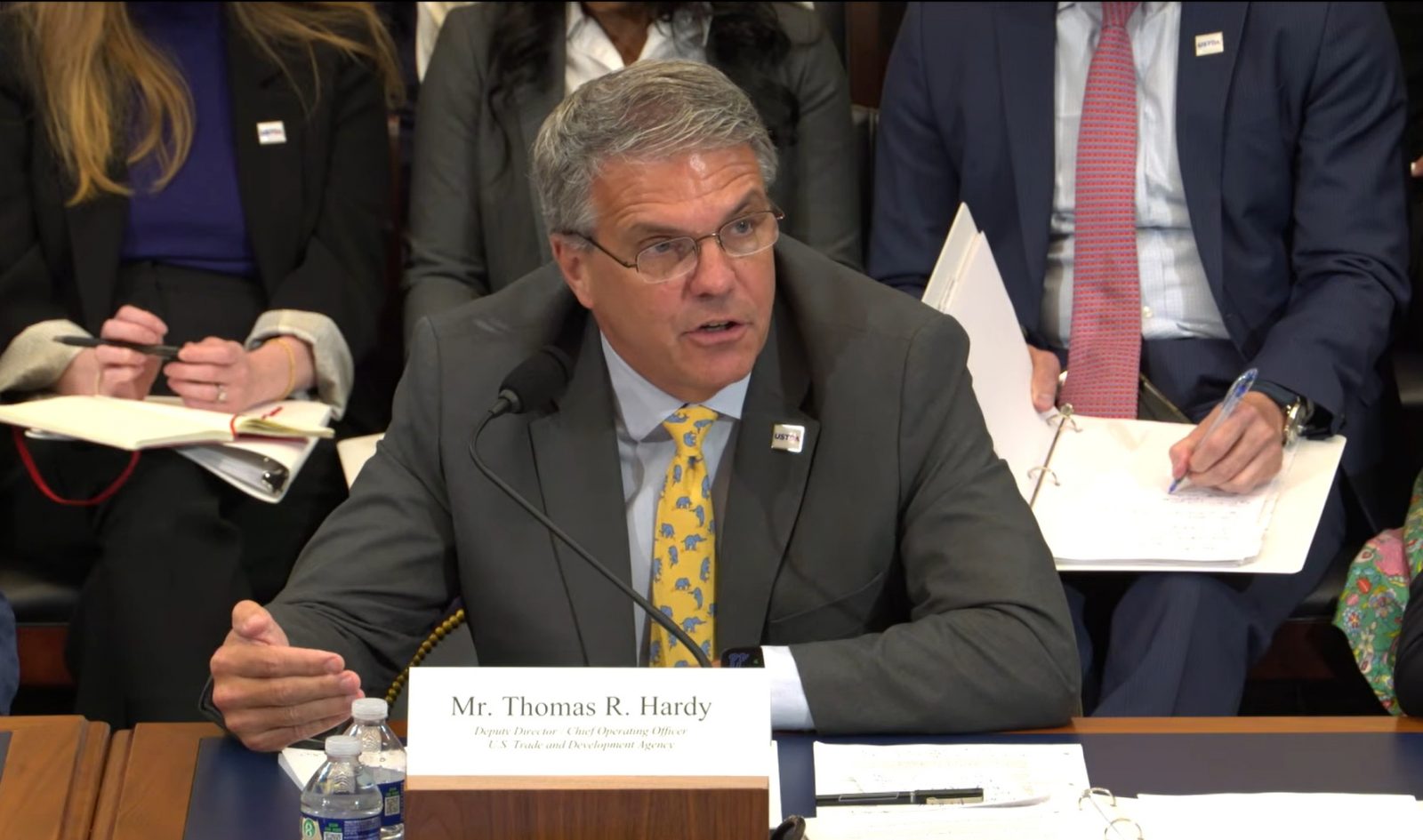
Arlington, VA – Today, USTDA Deputy Director Thomas R. Hardy delivered the following opening remarks before the U.S. House of Representatives Foreign Affairs Committee at a hearing entitled “Ending Supply Chain Dependency: Aligning Tools, Capital, and Partnership.”
Remarks as prepared:
Chairman Mast, Ranking Member Meeks, and distinguished Members of the Committee, thank you for the opportunity to appear before you today. I appreciate the chance to discuss how the U.S. Trade and Development Agency works tirelessly to help end America’s supply chain dependency by aligning U.S. tools, capital, and partnerships. My testimony summarizes the written statement submitted for the record.
USTDA serves as the U.S. government’s catalyst for critical infrastructure development in emerging markets. By funding project preparation – including feasibility studies, pilot projects, and technical assistance – we transform infrastructure opportunities into investment-ready projects that attract financing, expand opportunities for U.S. companies and, above all, advance America’s strategic interests.
We focus our work in the critical minerals, energy, transportation and digital infrastructure sectors, because they are the backbone of resilient supply chains that benefit America.
Africa is central to this effort. Along the Lobito Corridor, USTDA is advancing projects that support critical minerals development in Angola, Zambia, and the Democratic Republic of the Congo, while improving access to Angola’s ports. Our activities span power generation, mineral processing, and transportation infrastructure, while helping unlock investment, strengthen supply chains, and expand opportunities for American exporters.
We apply rigorous standards to our work, supporting trusted partners while avoiding projects that fail to meet high labor and environmental standards or that reinforce strategic competitors.
We are applying this same comprehensive approach in the Philippines, where our support for the Luzon Economic Corridor includes a 132-mile railroad to Subic Bay and an expansion of its port infrastructure to accommodate larger vessels and improve ship repair operations.
None of this work happens in isolation. USTDA prepares infrastructure projects for investment by coordinating with DFC, MCC, EXIM, and other partners to ensure our projects are structured to address these institutions’ financing requirements from the outset.
For example, we are currently working with MCC to prepare strategic digital infrastructure projects for MCC’s potential financing, including mobile connectivity in Indonesia and a national data center in Tonga. These efforts demonstrate how U.S. tools, capital, and partnerships come together to offer trusted alternatives to strategic competitors.
Two recent successes demonstrate how USTDA’s partnership-based model delivers results.
In Palau, the United States partnered with its Quad allies to design the replacement of a Chinese-built mobile network with a secure nationwide 4G/5G system built with trusted U.S. technology. USTDA funded the project’s technical preparation, laying the foundation for its implementation. In this geostrategic part of the world, this project has generated exports for American companies while strengthening Palau’s digital security and providing a model for nations across the Pacific seeking trusted telecommunications infrastructure.
In Sierra Leone, USTDA funded the initial project preparation for the country’s first natural gas-fired power project. That early work helped pave the way for $412 million of DFC financing and insurance, while complementing MCC’s investments to modernize Sierra Leone’s electricity grid. Together, these efforts again demonstrate how coordinated U.S. engagement can mobilize private capital, strengthen energy security, and deliver lasting economic benefits.
These examples reflect USTDA’s broader role within the U.S. government. We work closely with the Departments of State, Commerce, and Energy, as well as DFC, MCC, EXIM, and other partners to align America’s national security, commercial, and foreign policy objectives. By bringing together project preparation, financing, and trusted partnerships, we help reduce supply chain dependencies, strengthen America’s industrial base, and expand opportunities for U.S. companies.
Congress plays an indispensable role in this effort. We look forward to continuing our partnership with this Committee to ensure the United States has the coordinated tools, capital, and partnerships necessary to build resilient supply chains and reinforce American leadership around the world.
Thank you. I look forward to your questions.
###
The U.S. Trade and Development Agency is the U.S. government’s first mover on critical infrastructure development in emerging markets, advancing the shared strategic priorities of the United States and our overseas partners while creating opportunities to deploy trusted U.S. solutions. USTDA funds the upfront technical work that accelerates the development of infrastructure projects, helping them attract the financing they need for implementation and procurement of U.S. goods and services.
MEDIA INQUIRIES: press@ustda.gov